Paul Rouse: Autocrats have their own end game with the sporting world
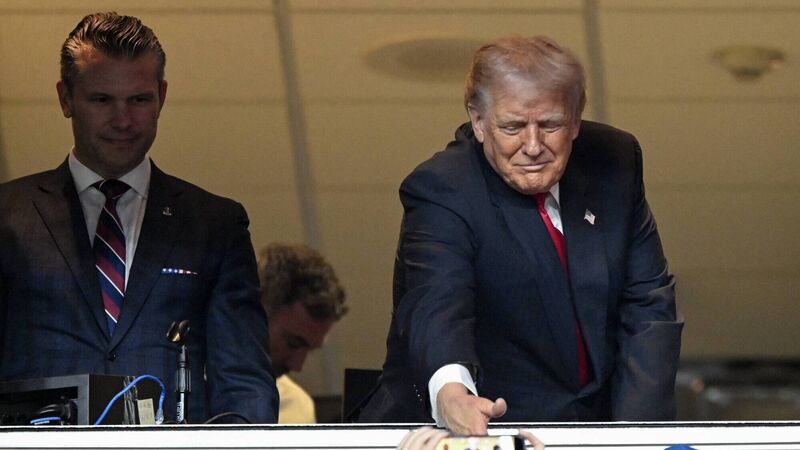
Secretary of War Pete Hegseth (L) watches U.S. President Donald Trump shake the hand of a young fan as he attends the NFL football game between the Detroit Lions and Washington Commanders at Northwest Stadium on November 9, 2025 in Landover, Maryland. Trump attended the game to honor military veterans during halftime of the game. (Photo by John McDonnell/Getty Images)

Anne Applebaum’s recent book was published to rave reviews. It is set out as a study of the way autocratic leaders around the world are linked together “not like a bloc but like an agglomeration of companies, bound not by ideology but rather by a ruthless, single-minded determination to preserve their personal wealth and power.” And not just “reserve their personal wealth”, but add to it in amounts that are obscene.
In a piece in the newspaper, John Simpson wrote that the book is “clear-sighted and fearless.” A review in the described the book as a call to arms, and simply “excellent”.
It is true that there is research to admire in the book and it is certainly readable, but to ignore its limitations is a mistake. For a book which ends with an appeal for the preservation of liberal society, its analysis of what caused the rise of autocrats is really limited.
This is because she does herself what she has criticised others for doing.
On the day that the famous historian Eric Hobsbawm died, Applebaum made a telling point that the absurdities of his defence of Marxism rendered the history books he wrote in his later years unreadable. She was right; Hobsbawm undercut himself.
The problem for Applebaum is that she is very close to doing the same herself. She seems unable to properly critique capitalism, the appalling failures of globalised “free trade” and the excesses of American imperialism.
In this failure, she misses the neglect of whole communities – in America and around the world – who were destroyed in a way that seeded the rise of Trump and his fellow autocrats.
There will be a reckoning from this, when it becomes apparent that these communities will be even worse off by the time Trump is finished with them in America. In Russia, the young men from the poorest places are now being fed into the meat grinder in the Donbas. More localised disregard for the lives of ordinary people can be seen everywhere from Argentina to Hungary.
What does this have to do with sport?
Identification with sport is invaluable for autocratic regimes. There is nothing new in this. Look at what happened in Italy, where fascism was invented. “Mussolini is building a new Rome”, the Pathé Gazette newsreel told cinema goers around the world in 1932. Using newsreels, fascist regimes skilfully elevated the propagandic value of sport with Pathé showing the newly constructed ‘Forum Mussolini’, declaring it a “Great Fascist sports ground”.
A marble monument to Il Duce stood outside the stadium and more marble statues inside represented every Italian province. The Forum had a capacity of 20,000 people when it was opened by Mussolini, who announced that a stadium next door would soon hold more than 100,000 and would be “the finest of its kind in the world”. In Italy, Pathé reported, “every form of athletic exercise and games is provided for.”
After seizing power with his Blackshirts in 1922, Mussolini had said: “I want sport to become a part of the national life of young Italy. Much can be done by physical fitness. Sport in all its forms is one way of achieving that object. Italy shall be a nation of sportsmen." This was sport remade as political show, with the iconography of fascism everywhere present.
Alongside newsreels, radio was vital to the idea of sporting spectacle. When Italy hosted and won the 1934 FIFA World Cup, most Italians followed the competition on radio. After that victory, in a competition which Italy spent a huge sum of money funding, the World Cup winning trophy was presented to the Italian captain Gianpiero Combi; that trophy was dwarfed by the ‘Coppa Mussolini’ which was also presented to Combi. The Italian press – notably Gazzetta dello Sport – proclaimed: “Italy is at the centre of the sports world”.
Now, in America, Trump sees sport as something that he can use in whatever way he wishes. That sport is so central to so many lives allows him use it as a vehicle to get into houses where otherwise he might not.
The checklist of what he has already done is striking.
Firstly, last January, on the first day of his second term in office, Trump used a theatrically framed desk in the middle of the Capital One Arena (the home of the Washington Wizards NBA team and the Washington Capitals NHL team) to sign a series of executive orders making dramatic change to a range of policies in America.
Secondly, he attended the most important sporting events held in America this year – the Super Bowl, the Daytona 500 motor race, the NCAA Wrestling Championships, a UFC fight – culminating in the final of FIFA World Club championship.
Thirdly, he used sport to prosecute his culture war, by banning transgender girls and women from competing in female categories in sport. This was amplified by tying funding to “sex-at-birth” proof.
Fourthly, he used sporting institutions and sports stars as his props. This extends from Gianni Infantino (the lapdog head of FIFA) to Cristiano Ronaldo, who was in the White House this week, along with a Saudi Arabia delegation.
Finally, he plans on using the World Cup next summer as his own personal vanity parade, an opportunity for the manifestation of his power and to extend his own grifting.
The power of America makes it very difficult to deny Trump this platform. It is more complicated for others. They can use sport to a certain extent – but sport can also create a negative scenario.
The glorious example of that this week is that of Viktor Orbán, the prime minister of Hungary. He has been heavily identified with the Hungarian soccer team, to the extent that he attended the Hungary v Ireland match in Dublin at the start of the qualifying campaign.
The loss of a late goal cost his team victory in that game and it was quite the sickener. This was as nothing compared to the late goal in Budapest last Sunday. It was not something that was in the autocratic playbook.
It would be a fool to overstate the importance of this blow to Orbán, but nor should it be dismissed. The shift in the public mood, whether in victory or defeat, is something with which we are well familiar in this country.