Special Springboks: The reasons South Africa stands alone
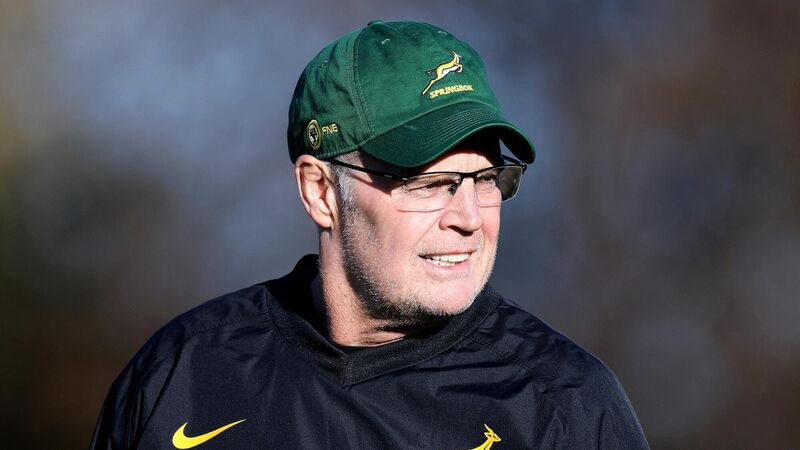
South Africa Head Coach Rassie Erasmus during training. Pic: ©INPHO/Laszlo Geczo.
How many black players are there in the current Springbok team? Who knows? It’s years since any of us counted. The Rainbow Nation dream of Nelson Mandela is a reality on the rugby field. It’s there, it’s tangible and it’s potent.
It was an iconic scene when Mandela wore a Francois Pienaar no.6 Springbok shirt on the Ellis Park podium as the 1995 World Cup was raised to the Jo’burg skies, the greatest power dressing symbol in global sport. In truth, though, it was an aspirational gesture rather than a truth of the time. A decade and more of quotas followed as South Africa tried to shake off its apartheid past, the media religiously counting how many players met the target. No more.
It was thought that football might become the national sport following the 2010 Fifa World Cup but the Springboks have captured hearts and minds. An hour or so before kick-off at the 2019 Rugby World Cup in Japan, when many of us were anticipating an English victory following their semi-final demolition of the All Blacks, a well-connected Springbok source warned me about the huge country-wide fever back in South Africa. The support makes for a profound impact.
Look at how many times the ‘Boks find a way to prevail. Every knockout game won by just a single point at RWC 2023. In 1995, Pienaar said that the defeated All Blacks were playing ‘a team of 43 million South Africans today.’ Siya Kolisi is the modern-day Pienaar and South Africa, all of them, are on top of the world.
Rassie has been called many things down the years – and he’s dished out a few barbs himself – but the fact of the matter is that he belongs in the pantheon of great coaches such as Carwyn James or Bob Dwyer or Ian McGeechan or Graham Henry.
In fact, he could make claim to being the best of the lot. Back-to-back World Cups (and who would bet against them making it three in a row in 2027) as well as successive Rugby Championships tells its own statistical tale but there is more to it than that. Erasmus cuts an imposing figure in his own right and has often done little to soften that intimidating persona. He’s a bruiser, orchestrating tirades against this or that refereeing decision.
He is his own worst enemy in that regard, presenting as a hard man when actually he is a multi-talented, nuanced man, capable of great love (particularly during the sorrowful aftermath of Anthony Foley’s death while coach at Munster) and possessing a rugby IQ that is beyond the wit of most people. From his traffic-light coaches-box signalling to Bomb Squads, Erasmus has the most innovative mind the sport has ever known.
Erasmus is constantly thinking ahead, hence the move to a more multi-faceted approach with wonderfully skilled players such as Sacha Feinberg-Mngomezulu and Damian Willemse being given their head. Rassie’s Springboks never stand still.
South Africa breeds big, tough buggers as a matter of course and it would be easy to ascribe their success to the fact that they have a conveyor belt churning from a never-ending source as deep as the Kimberley Gold Mines.
Physicality is in the South African DNA but so too is cutting-edge science. What the Oakland Athletics pioneered in baseball with its use of data and analytics, Erasmus has adopted and refined in rugby, that minute assessment of possibilities.
From the Bomb Squad to the four-subs-before-half-time strategy, Erasmus has so many options at his fingertips in order to maximise a perceived advantage or to react positively to a negative such as going down to 14 men on a seemingly regular basis.
There is no panic, no woe-is-me, now what-the-hell do we do? It’s all part of the plan. The cool-headed manner in which South Africa overcame the loss of Lood de Jager against France was a master-class in crisis management.
What used to be true of New Zealand (and Wales, long, long ago) is now true of South Africa – an endless stream of top-end talent. Three of World Rugby’s four nominations for Player of the Year are Springboks – Ox Nche, Malcolm Marx and Pieter-Steph du Toit.
The fact that rugby has managed to rekindle its mid-20th century status as a country that reveres rugby above any other aspect of life has enabled it to transcend its modern-day economic limitations. Just as the Wild Geese had to leave Ireland in search of work, so have many South Africans have had to pack their boots and go find employment.
Again, a negative is turned into a positive with younger players thrust forward to get experience at home while the galacticos sign on for the highest bidder in the UK, Ireland, Japan wherever.
That South Africa manage to make the most of this, players enhancing their skill set in different territories, makes a mockery of the restrictive policies adopted by the RFU and others. South Arica could field two XVs at the next World Cup and be competitive.
The Springboks like to tick off milestones to prove their worth. Back-to-back titles, historic victories in New Zealand, winning with 14 men. Their recent record against Ireland is a comparative blot in their copybook.
No win in Dublin since 2012. Ireland have won four of the last five encounters, Andy Farrell trumping Erasmus. That ledger demands righting.
Ireland, beware.