Tommy Martin: Rugby still chasing the dollar but America is a hard place to change
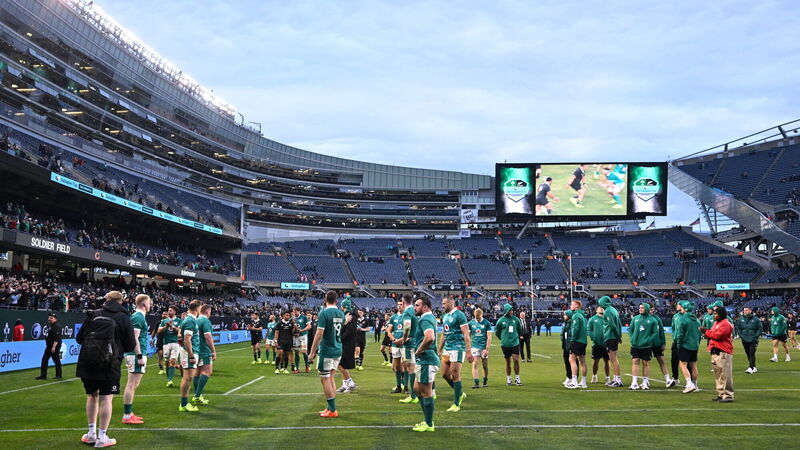
Ireland players after the Gallagher Cup match between Ireland and New Zealand at Soldier Field in Chicago, USA. Photo by Ramsey Cardy/Sportsfile

Back to Chicago for the Ireland v New Zealand game and, to my mind, the city hadn’t changed a bit in the 27 years since I’d been there, apart from one, sizeable thing – the Trump Tower, plonked right in the middle of downtown about a decade after I’d spent a J1 summer in the city.
The tower itself is fine, taking its place in the sweep of architectural wonders ranged along banks of the Chicago River. It’s just that it’s got ‘TRUMP’ emblazoned on it in bloody great, big, gaudy letters so that it feels like it is leering at you wherever you are in the downtown area.
Which I’m sure was only mildly annoying when the eponymous real estate mogul-cum-president was just a colourful figure in the US entertainment firmament. Now that he is the full-blown ringleader of an attack on American democracy, the building takes on a slightly more sinister quality.
Really, it’s another reminder that it can be hard to distinguish between what is fascism and what is just bad taste. None of the other buildings are quite so ostentatious about their owners, other than the Gothic Revivalist Tribune Tower, which carries the newspaper’s name in elegant script.
I get a lot of time to ponder on this as we are booked into a hotel directly across from Trump Tower and, to make up for some confusion over credit card details, I am given a room with a river view, which means opening the curtains every morning to a reminder of who is in charge.
I ask my friend Amanda, who has been living in Chicago for 25 years, about it. She says it pisses Chicagoans off no end, to the point where it has become a thing to take a selfie giving it the finger. The view of the longstanding Democratic city on the man in the White House: not a fan.
The news channels are dominated by one story: ICE and its terrorising of immigrant communities. Well, two stories, ICE and Hallowe’en, which to Americans is a sacred holiday, bringing together the solemn traditions of fancy dress and childhood obesity.
Illinois governor Jay Pritzker goes on the news to implore ICE to cease activities over the Hallowe’en holiday, so that children in the multi-ethnic city may have peace to enjoy their Reece’s Pieces and Sour Patch Kids without the threat of being teargassed by Trump’s federal militia.
According to Amanda, ICE target immigrants living and working in neighbourhoods like the one she lives in with her family in the northside of the city. Instead of busting up crime gangs and ne’er-do-wells, she reckons, they target nannies and hospitality workers, with the express intention of upsetting the comfortable lives of those who everyone knows will never vote for their master.
Community action groups have been formed to protect schools and businesses when ICE are on the prowl and people have been issued with whistles to blow when agents are spotted nearby, to alert anyone who may be at risk of being summarily rounded up and sent to a detention centre.
Amanda and Brian, her Chicagoan husband, reckon its all about normalising the act of throwing dissenters into camps, presaging an even darker authoritarian future. It’s why, like plenty Americans of their ilk, they have started looking at moving back to Ireland, or at least had depressing conversations with Irish estate agents about the possibility of acquiring a horrifically overpriced apartment.
I wonder though. For all the oppressiveness of having the great leader’s name looming over you as you wander the city streets, you still can’t beat the energy of the great American city. That much hasn’t changed. Chicago has the charge of the metropolis with a hint of self-effacing humour and without quite the sharp edges of New York.
You go to a Chicago Bulls game and, beer in hand and chicken tenders on your lap, are thoroughly entertained for two hours and leave with very little recollection of any actual basketball that happened. You cheer for the mascot, Benny the Bull, as he tries to win everyone a free hotdog by nailing a basket from the halfway line. The Americans know how to put on a show, you think, lamely.
You realise that sport in America is merely a conduit for the selling of beer and chicken tenders, and in fact that everything is, to the point where owning your own chicken tenders franchise and starring in an ad for it on a local TV network is the ultimate achievement in American life, never mind Superbowl MVP or the Congressional Medal of Honour.
This is why rugby is here, like many before them. To crack America is to plug into that charge, the naked consumerist life force that back home we find a little bit much. Some of the IRFU heads take in a Bulls match too and muse that they could do with some of that razzmatazz for Ireland home matches.
But they also know that people would just roll their eyes if you started playing Metallica over scrums or sent some lad around firing t-shirts into the crowd at the Aviva, and that any attempt to implement Kiss Cam would lead to widespread mortification.
Only in America, as they say. Another lame observation: there’s plenty money in Ireland. Thousands made the trip over to Chicago, piling into the bars and restaurants of the downtown area in the days leading up to game. More middle classes than huddled masses, this influx. You couldn’t go into a diner or deep-dish joint without some south Dublin family gathering over here, a scrum of middle-aged sons of Munster over there.
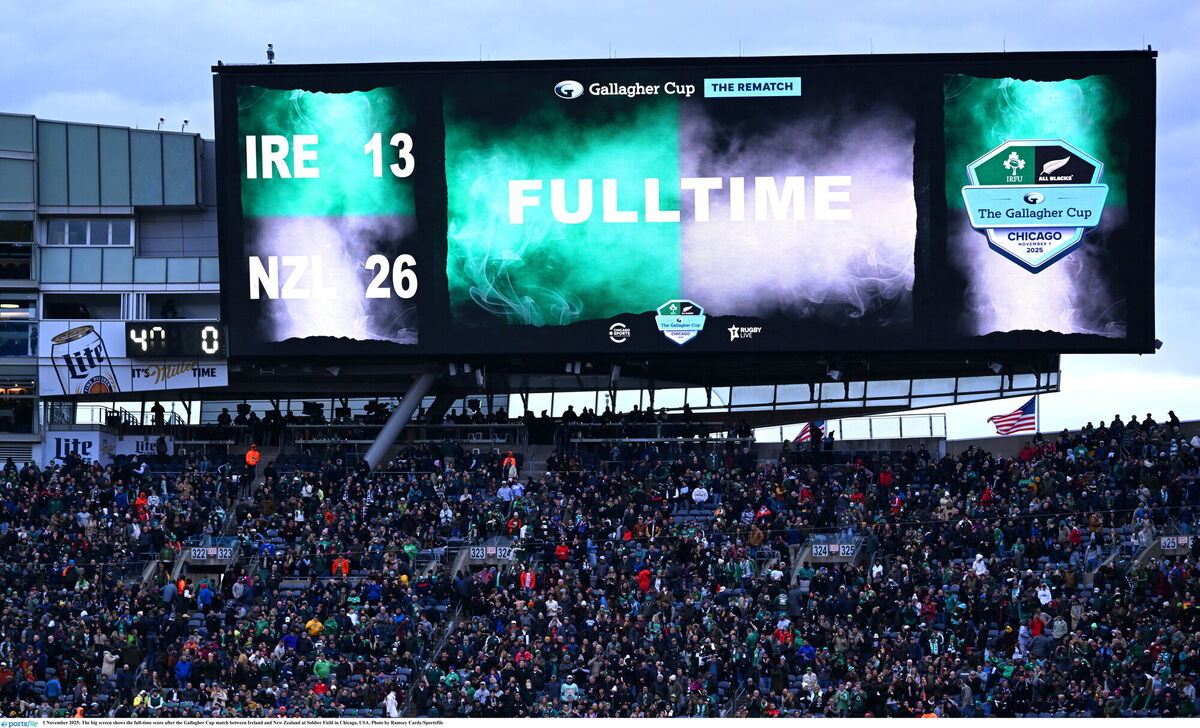
Rugby has money but it stretches only so far. You see it whenever the sport tries to reach beyond its limits. It is like the Austro-Hungarian army – magnificent marching up and down the streets of Vienna, a shambles when it crosses into enemy territory. The production in Soldier Field was shoddy, most noticeably on the TMO call that did for Ireland’s Tadhg Beirne. Nobody cared enough to check that all out beforehand, they were too busy counting the takings.
Soccer has been trying to get a hold in the US for decades and has only made a small beachhead. Rugby seems determined to keep pushing, at least until the World Cup in 2031. Ireland will be back in Chicago, so let’s hope they sort out the big screen for the TMO.
Even then it seems impossible to ever penetrate the attentions of most Americans, focused on the dominant mainstream American sports that were built into the national life long before Trump Tower or even the Tribune Tower. Despite everything, the US is a hard country to change, and maybe there’s something reassuring about that.