Christy O'Connor: GAA goalkeeping is now a constantly revolving door
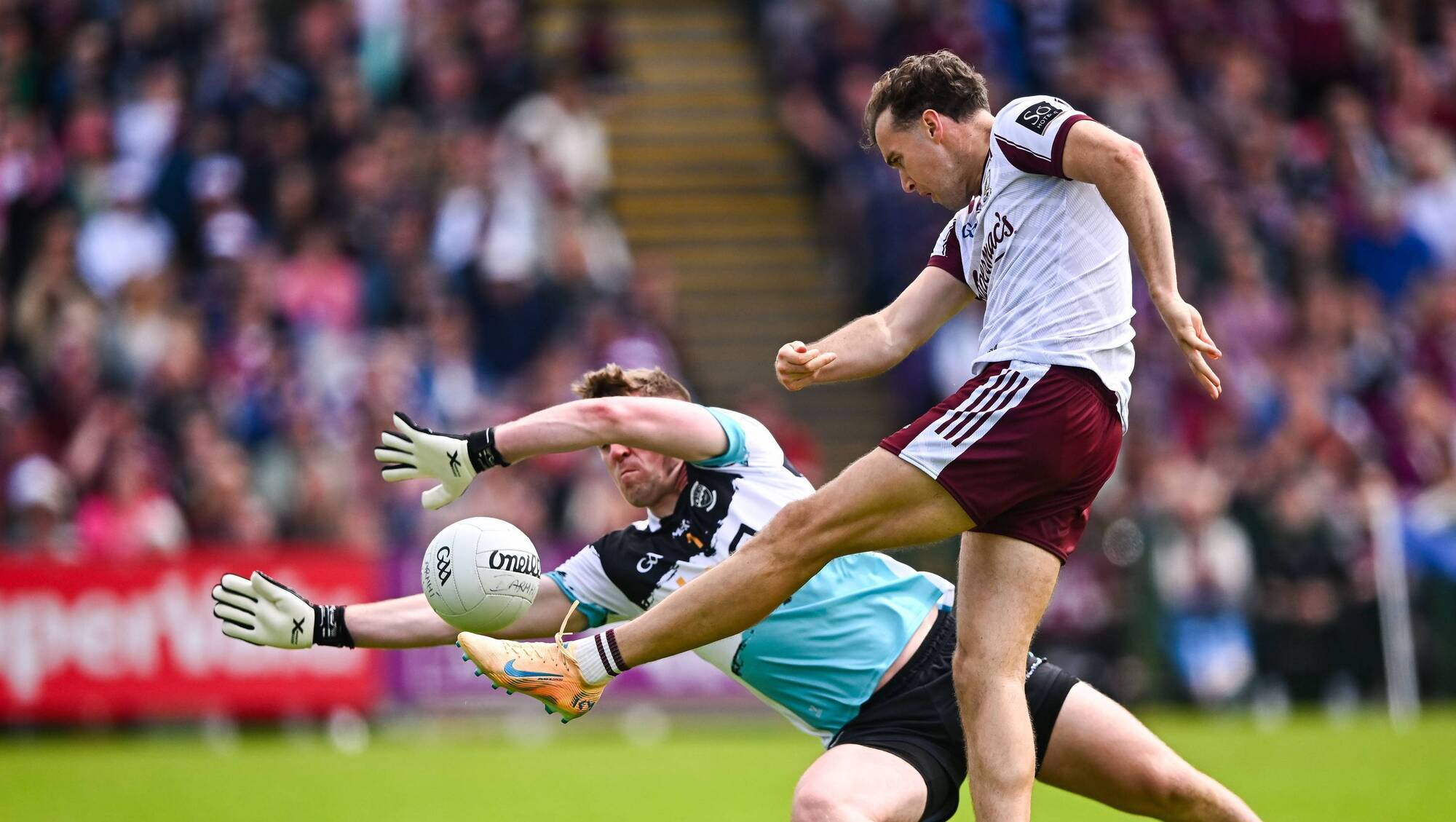
NUMBER ONE: Westmeath goalkeeper Jason Daly saves from Galway's Robert Finnerty. Pic: Piaras Ó Mídheach/Sportsfile

In the history of the World Cup, one of the greatest individual performances was Tim Howard’s herculean display against Belgium at the 2014 tournament in Brazil when the USA goalkeeper made an astonishing 16 saves, a record for a World Cup game.
From the moment Howard denied Divock Origi after 38 seconds that afternoon in Salvador, he continued to pull off saves with his left hand, right fingertips, legs, knees, chest, feet and even studs, some of which defied all logic.
Howard was an excellent goalkeeper but any time the USA participated at a World Cup, they always had a top class number 1, from Tony Meola, Kasey Keller, Brad Friedel, Howard to Brad Guzan. After Guzan, who won the ‘Golden Glove’ at the 2015 CONCACEF Gold Cup, stepped away from International duty, Matt Taylor stepped up, featuring in all of the USA’s matches at the 2022 World Cup in Qatar.
The position was always locked down going in to a World Cup but it was anything but settled heading into this tournament. Taylor and Matt Freese shared the responsibility during the USA’s friendly matches. Turner had all the big game experience that Freese did not but nobody had any idea who would start the opening game against Paraguay. “Not a ton of clarity,” said Turner a few days beforehand. “I think the messaging for me is to always be ready.”
Read More
Freese was equally in the dark as to what decision manager Mauricio Pochettino would make. “I dream of this opportunity,” he said last week. "But you never know if it’s going to come.” It finally did for Freese, who kept a clean sheet against Paraguay. Freese’s job now is to hold on to the jersey.
As professionals, soccer goalkeepers are used to that uncertainty and learn to deal with it. That dynamic rarely existed at inter-county level - but it emphatically has in this year’s football championship.
Of the 16 teams that entered the Sam Maguire after the provincial championship, seven have already used two goalkeepers; Armagh, Cork, Donegal, Dublin, Galway, Mayo and Westmeath.
Consistency was always associated with the position, but the evolution of the game has seen counties rotate on a much more frequent basis.
Some of the most established goalkeepers are still sure of their place. But outside of that select cohort, very few can settle into a rhythm of security like the number 1s of the past enjoyed.
Even those goalkeepers who thought they were safe, were not. An injury to Donegal’s Shaun Patton opened the door for Gavin Mulreany, who grabbed that chance with both hands, playing in all of Donegal’s eight league games, and in their opening two championship matches.
Yet when Mulreany’s kickout came under heat in the first half in Killarney, when Kerry won eight of his restarts and mined 0-5 from that possession, Jim McGuinness turned to Patton last weekend against Cork.
Rob Hennelly started eight of Mayo’s nine league and championship matches before Andy Moran handed Jack Livingstone his championship debut for the Monaghan game. After making a number of excellent saves, Livingstone retained his place against Tyrone last weekend.
Patrick Doyle, who has been outstanding with his kickouts for Cork in their last two matches, sat on the bench for their opening two games before being drafted in for the Munster final in place of Micheál Aodh Martin. Evan Comerford started Dublin’s three games in Leinster before being dropped for Hugh O’Sullivan for the Louth game in the All-Ireland series, and then being recalled for the Cavan match last weekend.
Padraic Joyce has a history of rotating his goalkeepers. Conor Flaherty featured in both of Galway’s games in Connacht but Connor Gleeson was the preferred choice for the last two matches. Flaherty’s clubmate, Eamon McGrath, also played two league games during the spring.
Jason Daly has been Westmeath’s first choice ‘keeper for their last four games but his opportunity only came after Conor McCormack got injured early on against Meath. Daly and Jack Connaughton rotated the goalkeeping position during the league, with Daly starting Westmeath’s first game against Longford before management rolled the dice by handing McCormack, a converted outfield player, his first start against Meath.
The only three goalkeepers of the 16 teams in the Sam Maguire to start and finish every league and championship game this season are Shane Murphy (Kerry), Liam Brady (Cavan) and Seán Brennan (Meath). Murphy has been outstanding but he has been given such a consistent run through an injury to Shane Ryan, last year’s All-Star ‘keeper.
After becoming used to looking over his shoulder, Blaine Hughes finally had some security this spring when starting every league game for Armagh. He played the opening round in Ulster against Tyrone and was named to start against Fermanagh before Kieran McGeeney drafted in Ethan Rafferty.
Hughes returned to give a kicking exhibition against Down, with Armagh retaining 21 out of their 22 kickouts. Hughes played against Monaghan and Derry before picking up an injury which reopened the door for Rafferty against Louth. Rafferty was solid all afternoon until his late mistake cost Armagh the game.
Rafferty starts again now against Kerry but if Hughes wasn’t injured, McGeeney would surely have rotated his goalkeeper again. “For me, I don’t see myself as the number 1 all of the time,” said Matt Turner a few months back. “That’s my mindset now.” And it has to be the same approach now for a lot of football goalkeepers.
Before the Limerick revolution began in 2018, one of the dominant themes of Limerick hurling prior to that breakthrough centred as much on their frustration to break out of Division 1B than their struggles to become a more consistent championship team.
Even when Limerick did win a Munster championship in 2013, before going extremely close to reaching an All-Ireland final the following year, their continued failure to emerge from 1B was deemed to be straitjacketing their long-term progress.
It was all the more galling again when some of that torture was self-inflicted. In 2014, Limerick were in pole position to go up ahead of Cork until they drew with Offaly in Tullamore. A year later, Limerick looked all but promoted before losing to Offaly in the Gaelic Grounds in the penultimate round.
That 2015 defeat had a destabilising effect on Limerick for the rest of that season, which carried into 2016, before John Kiely took over in 2017. During those two league campaigns, Offaly finished 5th and 4th respectively in a six team group. Offaly struggled to beat average teams in the league back then. But they still had Limerick’s measure.
That was a similar theme in the championship. A year after Limerick reached the 2007 All-Ireland final, Offaly knocked them out in a 2008 qualifier in the Gaelic Grounds. Offaly also beat them in 2010, albeit that was a weakened Limerick team when the players were on strike. Offaly also ended Limerick’s championship season in 2003. And nobody in Limerick still dares to speak about the 1994 All-Ireland final.
Offaly had Limerick’s number but that 2015 league victory was not only the last time Offaly beat Limerick – it was also Offaly’s last win against a Munster team. Most of the last decade was a write-off but, even when Offaly were more competitive in the 2000s, they couldn’t beat a Munster team outside of Limerick.
In their entire championship history, Offaly have only beaten Munster teams on six occasions, four of which came against Limerick, while they also beat Clare in the 1998 All-Ireland semi-final second replay, and Cork in the 2000 All-Ireland semi-final.
So, as well as the perceived gulf in talent, history also underlines just how monumental Offaly’s task is now against Cork on Sunday.
A video did the rounds during the week on X of how few Meath players from the current panel were part of the squad the last time Meath played Mayo in the championship in 2019. Of the 20 players which featured against Derry last Saturday, only four lined out in that Super 8s game seven years ago – Seamus Lavin, Donal Keogan, Bryan Menton and James Conlon.
All four started in both matches, but that’s an army compared to how few Mayo players are left from that 2019 squad; from the side which lost to Tyrone last Sunday, Aidan O’Shea is the only player to feature in both games – and he only came on as a sub in the 53rd minute six days ago.
Andy Moran – who played in that 2019 game - has stacked his squad with young talent but Mayo have been undergoing huge transition in the last two years. Despite all the heat Kevin McStay took last year, eight players made their championship debuts for Mayo in 2025.
Five of the starting team against Tyrone last weekend – Jack Livingstone, Eoin McGreal, Darragh Beirne, Hugh O’Loughlin and Kobe McDonald – have been handed their championship debuts by Moran. Another championship debutante in 2026, Cian McHale, was on the bench against Tyrone.
So while there has been big change in Meath, there has been far more transition in Mayo. And Meath’s greater worldliness could be the difference in Castlebar on Saturday.