Christy O'Connor: Jim McGuinness’s relationship with Kerry is now more personal than ever
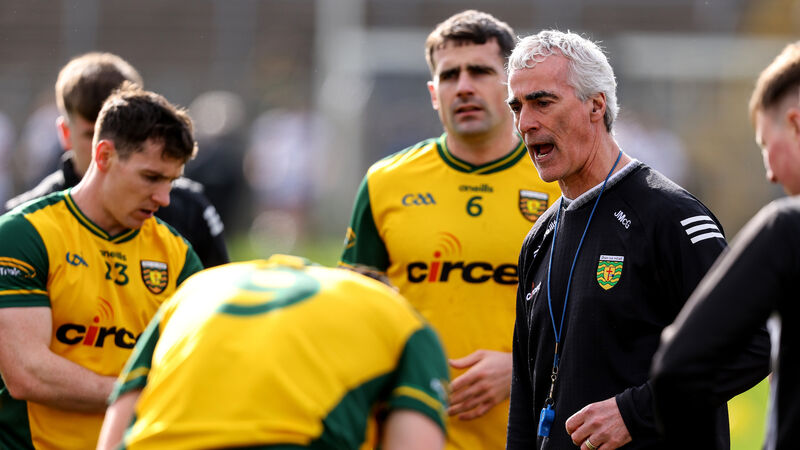
Jim McGuinness began his adult coaching career with Na Gaeil in Kerry. Pic: ©INPHO/Ben Brady
The week before Donegal played Kerry in the 2012 All-Ireland quarter-final, which was the counties first ever championship meeting, Jim McGuinness spoke about an ambition that extended a lot further than just wanting to beat Kerry; McGuinness also wanted Donegal to be more like Kerry.
McGuinness has always taken huge pride in how his teams have grown, fostered, developed and enhanced Donegal’s unique identity, both in terms of style and personality. But his background, especially in how McGuinness learned as much throughout his playing career from what Donegal often did wrong than what they did right, made it easier for him to look to Kerry for inspiration.
“Having lived in Kerry, where football is held in such high regard, it’s very easy to see just how they have won so many All-Irelands,” said McGuinness. “Every physical and human resource is put into it. They’re very passionate and professional about it.
“We want to develop a synergy in Donegal. A successful county team can energise the club scene and encourage more young players to get out on the pitch and play the sport. That will see a new generation coming through. And if that cycle continues that’s where tradition comes from. We’re only working towards that here at the minute.”
Within two years, that tradition was booming as Donegal reached both the 2014 senior and minor All-Ireland finals. It was the county’s first ever appearance in an All-Ireland minor final. Donegal lost both games to Kerry. McGuinness stepped down afterwards but the county was still well set up to profit from that synergetic approach that McGuinness had aspired towards.
Since McGuinness first arrived as manager in 2011, Donegal have won more Ulster titles (7) in the last 15 years than they previously won across their entire history (5). And yet, there were still years during that period when Donegal reverted to bad habits and poor culture (but not on McGuinness’ watch). In the three seasons since he has returned though, there is that sense that every physical and human resource is being put into Donegal winning an All-Ireland.
McGuinness may have only learned the importance of those values from a distance from his time in Kerry in the late 1990s – in Tralee IT - but that experience still formed and framed a significant part of his outlook, both as a manager and a person.
McGuinness was part of a decorated galaxy of stars on that Tralee IT team that won successive Sigerson titles in 1998 and 1999 (Tralee IT won three in-a-row between 1997-’99) but he saw up close just how much football meant to the Kerry players on that team, and to the county in general.
It also gave McGuinness a unique insight into the Kerry mindset, their devotion to the game and the county’s obsessive pursuit for constant improvement and success. For someone like McGuinness who was just as obsessive and devoted to football and learning, it was an invaluable education.
"Why did he (McGuinness) end up in Tralee?” asked Val Andrews, who managed Tralee IT in 1997-’98, in an interview on Newstalk before the 2014 All-Ireland final. “He came from Donegal to study in Tralee and that was driven by being fascinated with how Kerry won so many All Irelands. He wanted to learn from people and to look for the X Factor.”
By that stage of his life, education had become very important to McGuinness. He was 24 by then and had just completed his Leaving Cert at Donegal VEC in Letterkenny a few months earlier. Having left school after his Junior Cert, McGuinness embarked on a whole new educational path in his mid-20s.
Initially, he had hoped to go to Jordanstown but wasn’t accepted. Then he got a call from Tralee. At the time, they were looking to recruit students who played football and McGuinness was eligible because he was on an access course as a mature student and was classed as an elite footballer.
He educated himself inside and outside the lecture halls by immersing himself in the Kerry culture. McGuinness began his adult coaching career in the county with Na Gaeil. They were only Junior at the time and were playing in the novice championship but McGuinness trained them one night a week for one season. He couldn’t commit any more because he was back training or playing with Donegal every weekend.
Almost three decades on, McGuinness’ fascination with Kerry has become deeply intertwined with the public fascination around him. The intrigue has gone into overdrive since Kerry tore his coaching template to shreds last July. Kerry also exposed more than just McGuinness’s tactical system; they also exploded the aura around Donegal that McGuinness had cultivated.
The system was part of Donegal’s aura. That was the image but Kerry refused to see it. They just saw straight through it. Donegal were so welded to their principles and defensive zonal setup that Kerry tangled them up in their own doctrine.
Getting out-thought and out-coached in an All-Ireland final was always going to hurt McGuinness. It cut him even more when Donegal had also underperformed against Kerry in the 2014 final. There was a similar pattern too in how Donegal were flat and Kerry were far more aggressive in both of those of finals. And that’s on McGuinness too.
He took last year’s defeat even harder because McGuinness carries so much responsibility on his shoulders in how he forms and frames the Donegal operation. With Kerry the only county to have beaten McGuinness twice in championship, his affair with the county has become more personal than ever now.
After the 2014 final, McGuinness never had a chance to address that disappointment as he stepped away afterwards. But he has that opportunity now. And the former student has never been more desperate to teach the masters the ultimate lesson in 2026.
In these pages during the week, Cork’s Ian Maguire spoke to Eoghan Cormican about his hope for a promotion bounce similar to the all-conquering Cork team from the beginning of the last decade. After winning Division 2 in 2009, Cork went on to win three Division 1 titles in-a-row between 2010-’12, along with the 2010 All-Ireland.
That team had a worldliness that this group is still seeking but they are getting closer to accumulating it. Division One football next year will be a massive step in that process but being back in Croke Park for a national final now is a massive boost for Cork heading into the championship.
Unlike the current group, that All-Ireland winning side in 2010 were such regular visitors to Croke Park that they played at the venue far more often than they played in Páirc Uí Chaoimh. In a ten-year period between 2005-’14, the Cork footballers played in Croke Park a staggering 30 times.
Not being in Division One for a decade has been a factor but Croke Park has effectively become a wasteland for the Cork footballers since their great team broke up; in the last 12 seasons, Cork have played at Croke Park on just seven occasions.
Sunday’s Division Two final is a first national decider for Cork in 14 years but it’s also another big day out in Croke Park. It’s also an opportunity for Cork to win in Croke Park for the first time since March 2014, when they beat Dublin in the league.
The more Cork get exposed to the big days in Croke Park, the more comfortable they will become at Headquarters again.
Sixteen minutes into the 2015 Drummond Cup (Senior Colleges B) final in Croke Park between St Mary’s Academy Carlow CBS and Abbey CBS Tipperary, Colm Hulton collected a floated delivery and drilled the ball to the Abbey net. Hulton scored a priceless 1-2 that afternoon as Carlow CBS secured their first All-Ireland schools senior title.
By then, Hulton was also a Dublin minor. He had a chance to return to Croke park later that year but Dublin lost to Kildare in a Leinster semi-final. Shortly afterwards, Hulton’s football life with the Dubs took a U-turn. He headed back to Carlow.
It wasn’t a big deal because that’s where he has always lived. Hulton’s parents are originally from Fairview. Their son was born in the capital but only lived there for a matter of weeks before the family relocated to Carlow, where he enlisted with Éire Óg.
How did he end up back in Dublin? Éire Óg were in Birmingham one year for the Féile and they played Ballymun Kickhams in the final. Hulton got talking to a few Ballymun players after the game and became friends with them. As that friendship grew, so did thoughts of reconnecting with his Dublin roots. Hulton won a Carlow minor championship in 2013 but he transferred to Ballymun at the end of that season. In 2015, he won a Dublin minor title with the club, Ballymun’s first in 38 years.
Hulton spent five years with Ballymun but he was still living in Carlow and the long journeys and constant gridlock eventually began to take a toll. He transferred back to Éire Óg towards the end of the last decade. He was called into the Carlow panel shortly afterwards.
And now, 11 years on from that Drummond Cup final, Hulton – who is the second highest scorer from play in Division Four - is finally headed back to Croke Park with a Carlow team.