Right call, but wrong protocol

This tournament has known a number of twists and turns over the years but nothing quite as bizarre as the scenes witnessed on Saturday night in the Stade de France. For a contest of this nature to be postponed with the teams ready to take to the field beggars belief.
When referee Dave Pearson conducted his inspection at 7pm French time (6pm, Irish), I was stationed just meters away preparing for a live piece for the RTÉ Six One news. Pearson, along with his assistant referees and a contingent of officials undertook a brief inspection on the in-goal area at one end of the field as the protective covers were being removed. Within a matter of minutes, Pearson decided the surface would accommodate a game of this stature. I spoke to Pearson on his way to the dressing room and he appeared in good form and confident the game could go ahead. He also commented that the ground temperature in the stadium at 9pm would only be 0 degrees Celsius.
With the protective coverings that had been in place since the Italian game the previous Saturday now fully removed, both teams conducted their standard pre-match warm-up at either end of the pitch without any major difficulty.
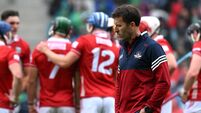
At this stage, I was perched in my commentary position for RTÉ Radio when with 25 minutes to go to kick-off, it was noticeable that Ireland coach Declan Kidney, along with new manager Michael Kearney, were engaged in deep conversation with a number of officials, including referee Pearson, on the half way line. Within a matter of minutes they were joined by a French contingent that included coach Philippe Saint-Andre. The discussions seemed to concentrate on two specific parts of the pitch, one adjacent to the corner flag and the other just outside one of the 22’s. At this stage, two industrial blow heaters were repositioned on those areas. These discussions continued for 15 minutes with Kidney separated from his team during their warm-up which in itself is highly unusual.
When both sides retreated to the dressing room for a final debrief, 10 minutes prior to the scheduled kick-off time, there was still no indication that this game was off. The first indicator I noticed that something was amiss was when members of the French reserve bench could be seen engaging with family and friends in the lower stand. When Imonal Harinordoquy and Yoann Maestri, both starters, emerged in their tracksuits, you knew the players had been informed the game was off.
Word finally filtered through from the RTÉ studios in Dublin that it had been cancelled yet it was another 13 minutes before any official announcement was made over the public address system in the stadium. During this period, the entire brass band remained positioned in the centre of the field in preparation for the national anthems, even though it was clear to everyone this game was not going ahead.
When that final announcement was made, and confirmed that the patrons’ tickets would be valid for a new date, understandably it was greeted with a cacophony of boos, jeers and whistles. Quite how things were left get to this late stage will take some explaining over the coming days. In the weather conditions that prevailed, maintaining a kick off time of 9pm seemed ridiculous in the extreme. The reaction from a number of Irish supporters that I met on the train back to the centre of Paris was one of outrage and disgust.
So what happens from here? The Irish supporters won’t be the only ones looking for a refund after this debacle. The IRFU will have incurred expenses in the region of €45,000 on travel, food and accommodation for the team, management and committee and will be faced with a similar bill for the rescheduled fixture. There is no guarantee, however, that this will be forthcoming from the Six Nations office. Unlike the Heineken Cup, there is no precedence or protocol in relation to events such as this. In the club competition the onus is on the host side to provide an alternative venue in the event of a pitch being deemed unplayable and is liable to a fine in the region of €70,000 for failing to do so.
As for the Irish team, a possible rescheduling to the weekend of March 2/3 means that they, along with France, will have to play four internationals on successive weekends. The French squad will be in a better position to cope with that. That said, there were concerns about Jonny Sexton’s groin coming into this game which may have effected his kicking. Stephen Ferris had an unsettled week’s training due to his citing and a number of the side were also suffering other bumps and bruises. At least when the teams eventually meet, Ireland should be doing so on the back of a win over Italy while France will have had to deal with a visit to Twickenham. Before then you can be sure that the blame game between the French federation and the Six Nations office will continue unabated.
On the field, Wales played some spectacular rugby in the 15 minutes after half time registering 24 unanswered points in a magical period of play. The power, pace and quick hands that characterised their play in Dublin was once again seen at its best. On this form, they are irresistible. Scotland, reduced to 13 men at one stage, finally shook off the shackles when the Edinburgh half back partnership of Mike Blair and Craig Laidlaw were reunited but it was too little, too late at that stage. If they continue their improvement over the next few weeks, Scotland may even make life difficult for Ireland in Dublin. Wales deserve their place at the summit of the championship table and when they have a full compliment to pick from will be difficult to beat.
England, somehow, are also unbeaten after two very ordinary performances against Scotland and luckless Italy. The Italians did everything but win in Rome on Saturday but badly need to find a place kicker. England have played no rugby whatsoever but still have maximum points. They will have to find some more inventiveness to continue that run and with more pressing challenges ahead could find that their fortunes are about to change. As for Ireland and France, you sense they would just like to have a game.