The kiss of death for female representation in politics?
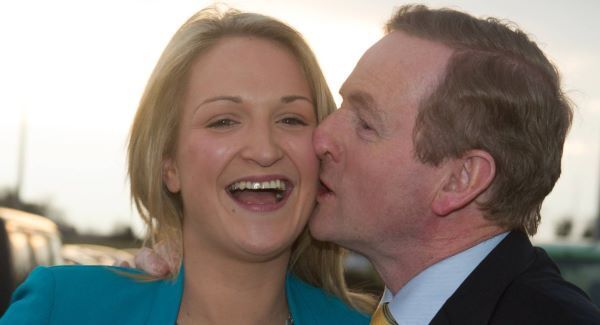
It was a Sunday morning party ‘family photo’ — the first event of the election campaign that he would go on to win — and Enda posed with a huddle of female candidates, all waving to the cameras. Days later, these women were nowhere to be seen for the more serious business of launching the party’s manifesto at a press conference with Mr Kenny, James Reilly, Michael Noonan, Phil Hogan, Richard Bruton and Leo Varadkar.
When questions opened up to the floor, Sarah Burke, health-policy journalist, said she was struck by the gender profile at the top table, and she asked if this imbalance would be reflected in a Fine Gael government. The Taoiseach said it was a coincidence that it was just men launching the document, because they happened to be the main spokespeople for the party.
It has become increasingly convenient in Irish politics for women to be seen.
But most parties are not so good at ensuring they are heard.
While women have achieved equality of photo opportunities, where the good optics of their presence has been recognised by spin doctors, this equality is not reflected in representation and, consequently, policy.
In the final days of campaigning in the recent Meath East by-election, Fine Gael consistently pointed out that its candidate, Helen McEntee, was a “young woman”, as though her gender ranked above her many other attributes as a strong contender.
But in the very week that she was elected to start her political career, her party seniors in Government pushed through a policy that would give banks the power to force many other young women to give up their careers.
The granting of the power to banks, under the ‘Personal Insolvency Guidelines’ — which would allow them to force parents to give up costly childcare — answered the question asked of Mr Kenny at the press conference in 2011.
Yes, a Fine Gael-led coalition — with a strong gender imbalance in Cabinet — would sometimes result in policies not favourable to women.
It came to pass, after that press conference, that just two women were appointed to Cabinet out of a possible 14 ministerial positions: Social Protection Minister, Joan Burton, and Children’s Minister Frances Fitzgerald.
Jan O’Sullivan has since been appointed a ‘super junior’, as Minister for Housing, and has a seat at the Cabinet table.
Recently, the most senior woman in Cabinet, Ms Burton, hinted at the consequences for policy of this gender imbalance.
In an interview on RTÉ Radio’s Miriam Meets programme, the Minister suggested that many of her colleagues have little direct knowledge of policy issues they are discussing, particularly when it came to “all sorts of struggles”.
Referring to the initial response to the Magdalene Laundries Report, which was seen as insensitive to the women involved, Ms Burton said: “You have a lot of men around the table and they haven’t had much contact with some of these issues.”
Although Mr Kenny subsequently took the time to listen to the women involved, and to treat their cases with sensitivity and compassion, the Government’s initial response provoked anger among victims.
Not only did the Taoiseach fail to apologise, when asked to in the Dáil, he appeared to rationalise what had taken place in the institutions as a consequence of the Ireland of the times.
Suggesting she had to push the issue for an apology to be given, Ms Burton repeated what she had said during the Cabinet meeting to discuss the initial response: “I was saying: ‘Hold on, there was a laundry attached to my school. I remember my mother on my holy communion day bringing me in’.”
The Social Protection Minister said the attitude of her Labour colleague, junior health minister, Kathleen Lynch, “was pretty much the same” when she joined the Cabinet for discussions on the report.
The question of whether more women in the higher ranks of power is actually good for women was under the spotlight this week, in discussions on the legacy of the former UK prime minister, Maggie Thatcher.
Thatcher has been criticised for not advancing the cause of women, despite being the first, and only, female prime minister of her country.
Indeed, Thatcher even hated to be referred to as such. It was recounted, this week, how she treated with disdain a question about what it was like to be a female prime minister. “I have no idea, dear — as I have never experienced the alternative,” she said.
A biography of her by Hugo Young described “the reluctance of this controlled and controlling woman to treat women, politically, as any different from men”.
He wrote: “She was against this on principle, apparently seeing nothing in her own rise to power which might prompt her to single women out for special attention … women as a separate category of voters were not of special interest.”
Her belief that her gender was incidental, and not with cause or consequence for her politics, was somewhat similar to Enda Kenny’s defence of his press conference line-up at the launch of his party’s manifesto.
But the actions of our Government since then have proven that women politicians are good for women, and that 50% of the population can lose out if their perspective is not adequately represented.
Thatcher might have been an exception to that rule, as she did little in her own government to weigh in behind the battle for equality and opportunity.
But at least she proved that women can be equally tough decision-makers, and are useful for far more than waving at cameras and bright and breezy photo opportunities.


CONNECT WITH US TODAY



Be the first to know the latest news and updates