14-17C
Some bright spells are possible in the south and east.

Find a...

Date Job Car Home


Why is the sky blue?
Mark Evans says parents should adopt a scientific approach to dealing with inquisitive children

SCHOOLS finish up next week and children across the land will rejoice. But spare a thought for the parents who will face a barrage of tricky questions from their curious kids.

Parents will be inundated with puzzlers and it’s the questions on science and nature that they fear the most. A survey carried out earlier this year in Britain found that 80% of parents have been stumped by science questions posed by their children. In an effort to save your blushes during a long summer of inquisition, arm yourself with some scientific knowledge, or cut it out and keep it handy in case you’re cornered with a conundrum. Instead of passing the buck to your more knowledgeable other half — or simply making up an answer — why not take the advice of everyone’s favourite scientist, Professor Brian Cox. “Inquisitive minds are fantastic, but clever questions can often leave parents in a tricky situation if they don’t have the answers. The best thing parents can do is work with their children to find the answers — not only can it be fun, but you’ll both learn something new along the way.”


So, if they want to know why the sky is blue, do aliens exist and what weight the Earth is, look no further for the answers. If they ask where babies come from... we’ll let you field that one! And don’t forget, we feature our Irish Examiner Weekend Summer Special tomorrow

1. Why is the sky blue?

The sun’s visible light is made up of the colours of a rainbow. All of these colours travel in waves of different sizes. Red has long waves and blue has short waves. Because blue has short waves, it bounces off the particles in the atmosphere more than red waves do, so it looks like the blue light is coming from almost every direction.

2. How are sea waves made?

Generally, the waves you see at the beach were caused by the wind far out to sea. The wind energy causes the water to move up and down. The energy carries all the way to land where it raises up the water once it enters the shallows.

3. Why is the sea salty?

Salt is a mineral found in rocks. Rain washes the salt into streams and rivers which take it to the sea. The sun evaporates water to form rain clouds, leaving the salt in the sea.

4. How do ships stay afloat?

Because they’re hollow. If you had a 1kg lump of gold and dropped it in water, it would sink. This is because the weight of the water it displaces is less than 1kg. But if you moulded the gold into a 1kg bowl it would float. This is because the weight of the water it is displacing weighs more than 1kg.

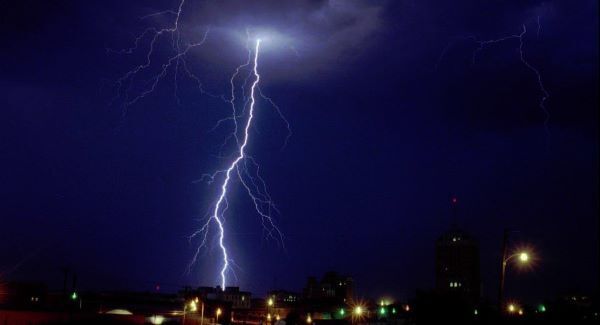
5. Why do we see lightning before hearing the thunder?

Because light travels faster than sound, but they both occur at the same time. Light travels at about 300,000km per second, while sound travels at 340 metres per second. You can work out how many miles away the lightning is by counting the seconds between the flash and the bang, then divide by five.

6. What is the fastest thing in the universe?

Light. It travels at 299,792,458 metres per second. Nothing can travel quicker. However, this doesn’t mean light can’t go slower. Scientists have slowed laser beams down to just 17 metres per second.

7. How are rainbows formed?

You will only see a rainbow when the sun is behind you. Imagine a huge raindrop in the sky. When light enters, it is split into red, orange, yellow, green, blue, indigo and violet and reflected out. You will only see these colours when the light leaves the imaginary raindrop at an angle of 42 degrees to the angle it entered. Now imagine billions of tiny raindrops in the sky, all reflecting the rainbow colours to you. Because of the angle needed you will only see the colours from the raindrops that are at the same angle from you — which creates the rainbow arc.

8. What is the highest number?

There is no ‘highest’ number because you could get a bigger number by simply adding one to it.

However, there are numbers that mathematicians use which are really big, such as: a googol (1 followed by 100 zeroes) and a googolplex (1 followed by a googol of zeroes).

The highest number used by mathematicians is called Graham’s number, which is so large that there isn’t enough room in the universe to write it down.

9. How do fish breathe?

Fish use gills instead of lungs. When your goldfish is mouthing ‘bob’, it is actually drawing water into its mouth and squeezing it out through its gills.

When the water is passing over the gills, filaments loaded with tiny veins take the oxygen out of the water and into the fish’s bloodstream. The gills also get rid of the water and carbon dioxide.

10. How deep is the sea?

The average depth of the world’s oceans is 4 kilometres. The Arctic is just 1km deep on average, while the Pacific is 4.2km deep on average.

However, the deepest point anywhere in the seas is called Mariana Trench, south of Japan. Filmmaker James Cameron (of Titanic and Avatar fame) became the first person to reach that point on his own, back in March.

It is 11km deep.

11. What is the Moon made of?

Scientists believe that when the Earth was being formed, a body the size of Mars smashed into it and blasted rock into space. This material gathered in orbit around Earth and cooled to form the moon. Basically, the Moon is made of the same stuff as the Earth.

12. Why do we burp?

Two reasons: mainly because gasses build up in our stomachs when we are digesting food and also because when we eat, we swallow air. Better out than in!

13. What is the deadliest animal?

Apart from humans, the creature that is responsible for the greatest number of deaths is the tiny mosquito. By carrying the deadly malaria virus, it kills about two million people each year.

14. If you dug a hole straight through the Earth where would you come out?

If you started in Ireland you would emerge about 500km south of New Zealand. The problem is that to do so you would have to dig a hole about 12,500km deep and survive temperatures of 4,300C at the Earth’s core, almost as hot as the surface of the Sun.

15. Which words do we use the most?

There are over a million different words in the English language with new words being added and old ones falling out of use every year. The top 10 most used words, in order, are: the; be; to; of; and; a; in; that; have; I.

16. What happens when we get ‘brain freeze’?

This occurs when ice cream or a very cold drink comes in contact with your palate. The blood vessels there immediately contract, but then the blood quickly rushes back to the area in an attempt to warm up the roof of your mouth. Facial nerves tell your brain that there is a pain in your palate but it thinks it is coming from your forehead.

17. Why is grass green?

Blades of grass are superb solar panels, soaking up the sun’s rays. A chemical called chlorophyll absorbs the high energy blue light and low energy red light, and turns it into sugar (food). However, chlorophyll reflects the medium energy green light, which makes the grass look green.

18. Do aliens really exist?

We don’t know, but scientists are constantly looking. Astronomers are finding hundreds of planets around other stars in our galaxy and some lie in what’s called the ‘Goldilocks zone’, a region around a star where water exists in liquid form. Scientists believe where there’s water there could be life.

19. What is the oldest living thing?

Depends on what you mean by ‘living’ and ‘thing’. If you discount periods of suspended animation or being frozen, it would be the King’s Holly plant from Australia, which is over 46,000 years old. If you allow organisms that have been ‘hibernating’ then it would be a bacteria found in New Mexico, revived after a 250m year sleep!

20. Why do we have belly buttons?

Our navels are scars showing where we were joined to our mothers via an umbilical cord, through which we received food and oxygen-rich blood. Once we are born, the cord is cut close to the abdomen, which becomes the navel. 90% of people have ‘innies’.

21. How old is the Earth?

All of the planets formed out of a gigantic dust cloud, shrouding the young sun, billions of years ago. The Earth is about 4.54bn years old. The first signs of life appeared about 3.5bn years ago. If the entire history of Earth was condensed into a day beginning at midnight then life appeared at 4am, dinosaurs roamed at 10.56pm and we only arrived at 11.58.43pm!

22. How far away is the Sun?

The Sun is 150m kilometres from Earth. To give an idea of how far away the Sun is, it takes light 8 minutes and 20 seconds to travel from the Sun to the Earth.

23. Is time travel possible?

Yes, but only into the future. Travelling into the past would allow paradoxes such as preventing yourself from making the trip in the first place. All you need to travel years into the future is either a machine capable of reaching near light-speed, or to move near a massive object such as a black hole.

24. Why do we get burnt by the Sun?

The Sun’s heat doesn’t burn you. That’s why you can get sunburn on a cold clear day. The Sun’s heat is its infrared radiation, but it is its ultraviolet radiation that damages your skin. UV rays damage your DNA and the redness and soreness is your body’s reaction to this damage, trying to repair the damage.

25. And finally... are we there yet?

No! Star Trek-like teleportation is possible in theory, but until it is invented we just have to put up with journeys between two points taking time relative to the distance between them.


The next 25 questions are available to view here.Home

More from the Irish Examiner