Watch, listen and learn with RTEjr
The developments will see the station increase its children’s output by up to 34 hours a day.
The channel has been in development for 12 months and is part of RTE director-general Noel Curran’s six-point plan to update the broadcaster.
Head of children’s programming Shiela deCourcy was charged with the implementation of a three-year strategy. The first fruits of her labours are now being enjoyed by tots and teens up and down the country.
“I think you’ve got to constantly examine and re-examine what you’re doing in order to make sure that your output is in keeping with where your audience is at that moment,” says deCourcy. “In many ways children are the most challenging because for them there’s no such thing as new technology; for them content is content, they don’t have a history. So it’s very important that RTE provides a service to meet them where they’re growing up.”
Although most right-minded people would probably applaud RTE’s endeavours to cater for younger audiences some might argue that children were being offered plenty of TV already on RTE 2. Those in the ‘they’ll-get-square-eyes-brigade’ might argue that too much television is damaging. deCourcy is quick to point out the benefits of having a children’s channel, and believes RTE’s remit is to provide an offering but not to babysit.
“What we offer is a very safe, and most importantly ad-free place where children can watch top quality Irish and international children’s programmes which is available 12 hours a day,” says deCourcy. “Not that we are suggesting that anyone watches TV for 12 hours a day, but we’re making it available.
“How much TV a child watches is up to the parent or guardian.
“But there are a couple of interesting points around that,” continues deCourcy. “Many children find television relaxing, for instance. Most of our programmes have a very high level of interactivity too, be it learning how to dance, be it repeating words that come up on the television; so it’s not just passive watching.”
deCourcy acknowledges the fact that in this new digital age there is a wealth of children’s channels to choose from including CBeebies and Nickleodeon. She believes that it is for that very reason that RTEJr is so important now.
“Audiences now have a huge range of channels to choose from with digital television,” she says. “In that context, it was up to us to provide a channel that would be culturally relevant to Ireland. We’re looking at the cultural welfare of children. Ultimately they have a right to it and as a public broadcaster we have a responsibility to them.”
With that in mind, but obviously without the budget of the BBC, deCourcy has endeavoured to make as many of RTEJr’s programmes in Ireland as possible and she estimates that between 30 to 40% of the new television output is Irish with all of the radio content made at home.
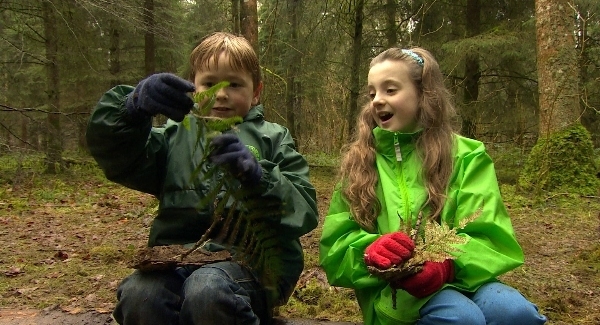
One of the simplest and yet most enjoyable new shows is Forest Force which each week sees four children undertake a forest challenge which aims to teach them a respect for the forest environment and a broad range of skills such as compass reading, bark-boat building and bug hunting.
“RTE were looking for a programme based on nature and the outdoors,” says programme producer Tamsin Lyons who runs Ink and Light Productions in Dublin with her Finnish partner Leevi Lemmetty. “At the same time we had just come back from Finland where we had been staying in a town called Espoo, I think it’s called the garden city, and we were really impressed by the kids there and how at home they were with nature and being out in the forest.”
Using their experience in Finland to draw inspiration for a programme proposal, Ink and Light approached RTE with the idea for Forest Force.
“We wanted to find a way of encouraging kids to get out into the amazing forests that we had here,” explains Lyons. “And so when we saw the brief that idea immediately sprung to mind.”
In many ways Forest Force reflects the ethos of interactivity, activity, learning and discovery that deCourcy and RTEjr are trying to promote.
“For youngsters there’s a lot of cross media content that can be consumed and it develops different skills. So there’s the app and games on the web and the radio channel is very important. The radio content is all original content. We’ve had a terrific team working on it. You know, listening is a terribly important skill for young people to develop. I’m really hoping that people will get involved in all sides of it.”
CONNECT WITH US TODAY



Be the first to know the latest news and updates