‘I needed to find out who I really was’
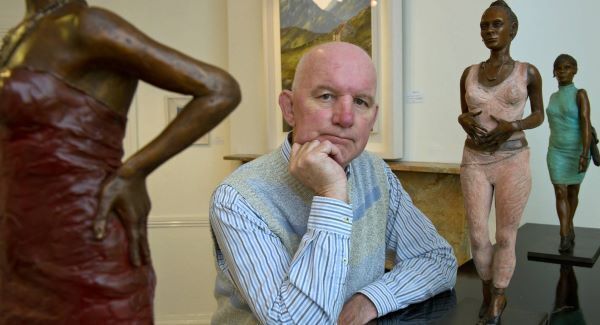
MOST people would have been content to have achieved by their early 50s what Patrick Campbell had: the creator of a successful business, Campbell Catering, which employed 5,000 people, and the saviour of another, Bewleys, which he expanded from an ailing café into a multinational tea and coffee supplier. Campbell wanted more: to be an artist.
Flash forward 15 years, and Campbell, at 70, can look back on a successful second act in his life. He shows regularly in Ireland, Britain, Italy and America, and was asked to sculpt a bust of Mary McAleese during her presidency.
Campbell, a genial storyteller with an unassuming, assured manner, says there was business logic in his decision to ‘give it all up’: “I used to do business plans,” he says as we sit surrounded by his work in Gormley’s Gallery, Dublin.
“My approach to it was to ask, ‘where do we want to be in five years’ time, 10 years’ time? How do we get there’? I said to myself, ‘where do I want to be in my own life’? I was getting on, in my early 50s, and beginning to ask, ‘what’s it all about’? I had a good business going, that was fine, but I wondered was there something deeper I needed to do, to find out who I really was?”
Campbell took night courses at the NCAD, but thought them limiting. So, in 1996, he asked his son, Duncan, an artist living in Glasgow, for advice and he recommended a month-long course in Renaissance painting and drawing in Florence. Campbell loved it so much he repeated the trip for years afterwards.
Yet it was only after seven years that Campbell stumbled upon his true calling: sculpting. “I didn’t think I’d like it, or that I’d be any good at it,” he says. “I thought I’d do it to improve my painting. But as soon as I started it, I found I had a gift for it. I was completely flabbergasted how it came to me. I could paint alright, but it was a conscious effort. But with sculpture it seemed no problem.”
After suddenly finding himself a natural at sculpture aged 58 years, Campbell began, as he says, “to stretch the umbilical cord” between his business life and his artistic life, managing his affairs so that he could have free time, hiring the right people to run the business for him.
If he was to advise anyone on changing their course in life, he says it would be not to do it in a hurry.
“I remember,” he says, “the kids would say, ‘Dad, you’re a great delegator, always giving us jobs to do.’ That’s my strength. I’m actually not good at cooking, or accounting, or serving tables: anything you could say is the cornerstone of a business. What I am good at is delegating, I think that’s the point I got to in my business life. It’s a big problem for most entrepreneurs: they don’t know how to do it, but I had a natural ability to.”
That natural ability has seen Campbell hold his directorship of Campbell Bewley, but put most of his time into his art. He studied full-time for three years in Italy, and began dividing his time between Florence, where he keeps his studio, and Dublin.
Moving to Florence to become a sculptor is like moving to Dublin to write an epic, modernist novel about the events of one day: there’s a local reputation to contend with — and Campbell’s own work sits in that tradition of Renaissance naturalism. Yet for Campbell, the daunting place, for a time, was Dublin, where he had to prove himself more than a mere dilettante retiree. “The big problem in Ireland, although I shouldn’t complain about this, is that it’s a very social place. If I try to work here, which I have done from time to time, everyone wants to go for a pint, or coffee.
“Also, it’s hard to break away from your previous life. People know me from business and they think art is like golf. ‘You’re sculpting, and I’m playing golf.’ But it’s not like that, it’s serious.
“So I go to Florence, where they only know me as a sculptor, and live pretty well like a bachelor. I come and go when I want to, I can work as long as I want to, there’s no one waiting for me. It sounds boring in one way, selfish in another, but that’s the way I like it,” he says.
Of course, there’s a family in all this, too. How does Campbell’s wife, Veronica, deal with this new life? “I don’t know. I never asked her,” says Campbell. “If you’re an artist, you can’t ask people if it’s okay if I do this, that or the other. In a way, an artist has to be selfish, and say ‘I need to do this.’ But she understands. She’s artistic by nature. She loves painting, reading. The theatrical side of my daughters [Siofra, a screenwriter, and Kelly, an actor] came from her. Veronica visits, but she doesn’t like the very hot weather, or the very cold weather, and Florence gets both.
“So, spring and autumn she’d come over, and I’m over and back all the time, so it’s not as if I’m there nine months of the year and nobody sees me.”
A cynic might look at Campbell’s life and see a wealthy man’s fantasy: sipping espressos in the squares of Florence and contemplating his next work while strolling, gelato in hand, on the banks of the Arno.
But to hear him discuss the work dispels any notion of a talented dabbler. Campbell’s new life is about exploring himself as much as his talent.
Campbell says the artist and the entrepreneur have much in common, with their unstructured working lives and constant problem-solving.
Yet there was a part of being an artist for which nothing prepared him.
“The psychology of it can be very troubling sometimes,” he says. “But you have to believe it’s an important part of the process. Art is very emotional, and it’s different to business in that sense. You become very troubled by it if it’s going wrong, almost like a sick child; it’s an amazing sensation in that way.
“You get a sense of frustration, loneliness, even pointlessness sometimes: why am I doing this, what’s it all about? But yet, you have to let yourself suffer a little bit. If you’re happy and tranquil all the time, there’s something about the art that doesn’t happen.
“You need almost to allow yourself into that mode of depression to have the upswing, the moment of greatest creativity.”
* Solo 70, an exhibition by Paddy Campbell, is at Gormley’s Fine Art. Dublin, until Aug 12. The show travels to Gormley’s Belfast gallery in August, and to Petley’s Fine Art, London, in October.
CONNECT WITH US TODAY



Be the first to know the latest news and updates