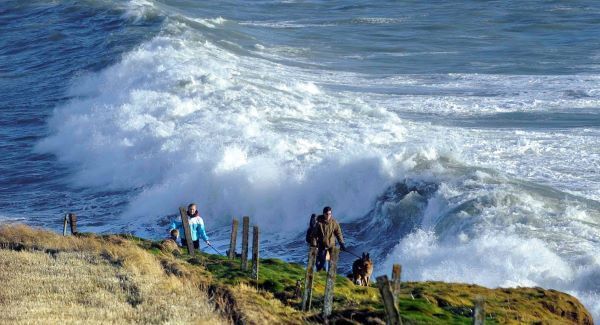
The coast is clear
Thursday, July 19, 2012
Get ready for Ireland’s answer to the Great Ocean Road — the 1400km Wild Atlantic Way, says Tommy Barker
By Tommy Barker
THE wetter, the better. The wilder and worse our weather, the more a new Irish tourism package will deliver on its promise.
If the sun shines, and the skies and seas turn blue (it has been known to happen), who’ll complain if fields turn gold, the ocean calms to a millpond, and you fancy you can see America to the west? Good weather will be a bonus.

Failte Ireland’s nomenclature, Wild Atlantic Way, for their planned major tourism route smacks of genius in three short and succinct words.
Don’t say you weren’t warned — it’s like putting the small print up in big letters; it’s not only weather-proof, it’s fool-proof.
The Wild Atlantic Way already has a ring to it. It’s not due to be rolled out until 2014, though the pilot project is underway in the coastline’s mid-ships section, in Connemara.
The route ties the country’s western fringes together, from north to south, and creates a brand with an international lure. Think Route 66, only with potholes, pranksters turning signs the wrong way around, and the odd bit of grass in the middle of the road.
The Wild Atlantic Way picks up on the appeal of classic, scenic driving routes like South Africa’s 200km Garden Route, or Australia’s 250km Great Ocean Road, only it goes further — a lot further. It’s 1,400km, from Malin in Donegal to Clonakilty in West Cork, although the exact route isn’t finalised, so expect local politics to enter the fray.
Even with a car or motorbike, you could knock days and weeks out of it, a few summers of visits, even, like the Camino de Santiago, whose pilgrim walking routes to Santiago de Compostela run up to 800km, yet can be broken into manageable stages. It attracts up to 300,000 visitors every year.
Selling Ireland’s western seaboard is a rare example of joined-up thinking here, and it could redress the balance of Irish tourism: Dublin gets the lion’s share of visitors (nearly four million a year) thanks to its accessibility and convenience for short, city breaks.
The Wild Atlantic Way? It’s there for the long haul, both for domestic and overseas visitors.
The further beauty of it is that it will not be dogmatic, not like mind-numbingly following a motorway from point A to point B, in the most effective manner.
It’s like the difference between ‘fast food’ and ‘slow food’ — it’s about taking visitors off the beaten track, and slowing them down, right down. Increasing the ‘dwell time,’ in tourism jargon.
Failte Ireland’s Paddy Mathews says that while the Wild Atlantic Way is a driving route, hugging the coastline as much as is practicable, it is more than that: he expects cars, and other vehicles travelling it to be carrying boots for walks, racks for bikes, and to have roof racks for surfboards or other outdoors paraphernalia. “It’s about getting them out of the car as much as possible and spending time in the places they visit.”
Thus, the plan — it’s being piloted in Connemara this year with a €1.8m spend — is to add viewing points and lay-bys, add signage and interpretation at what’s called ‘discovery points’ and to tie them in, wherever possible, with trail-heads and existing routes for cycling and walking, or cliff or beaches for surfing or fishing.
It will all be backed up by brochures, maps and apps. Connemara’s pilot will cover 20 of these ‘discovery points,’ so the full 1,400km of the Wild Atlantic Way should number more than 100 such spots. While the main spine route will approximately follow the coastline, it will possibly break up into three or four sections, each with a different flavour, such as the north-west, the west, and the south-west.
It will add a supra layer of branding on top of existing, known routes or brands, be they the likes of the Kerry Way, or the recently developed Great Western Greenway and its 42km of off-road track, by Westport, or even the more-encompassing Fuchsia brand in West Cork.
Mr Mathews says that the Wild Atlantic Way will meander through the territory of 12 local authorities. Already, along its planned path, are 35 short and scenic driving routes, yet only three of these cross over county boundaries. This is bigger-picture thinking, with its spurs and loops and urgings to follow a defined path, but also break away from it: it even dovetails with those key, and heavily branded, words ‘discover Ireland.’
Mr Mathews says “it’s an important part of ensuring Ireland is able to provide visitors with an unforgettable experience. It will open up a huge number of towns and attractions to them, and showcase the scenery and unique culture of the west coast of Ireland, providing easy access to a range of experiences along the route.”
The Wild Atlantic Way is, in effect, an over-arching brand that can easily compartmentalise all others under its 1,400km (and counting) reach.
So, the Wild Atlantic Way will embrace existing attractions and activities, and all of their coastal variations: things like food and seafood, golf and links courses, scenery and sunsets, wildlife and whale-watching, craft and the abundance of artists drawn to areas of outstanding natural beauty, and, just when you think you’ve the Wild Atlantic Way tamed and it’s a case of auto-pilot on the GPS, you can take time out again and, oh, visit an island with a ferry pilot.
It’s a tourism coup, combining our strengths of stunning images and scenery, culture, food, folklore, sport, history, and everything can be bundled into the Atlantic marketing maelstrom: as Mr Mathews says “it’s got singularity, and scale.” Singularity is what’s made ‘the Camino’ such a by-word and identifiable journey, although the Camino has hundreds of years of Christian pilgrim history in its favour. As well as its singularity and ready identification with the coastline, the fledgling Wild Atlantic Way gets its considerable scale from the length of our indented coastline, north to south along the western corridor: if you were to follow every promontory and boreen, you could probably double its length.
It’s a racing certainty that once it takes off, there’ll be ways devised of lengthening it, shortening it, looping it, and doing it backwards, via shank’s mare, or with a horse, a cart, by bike, on a unicycle, wheeling a fridge, swimming it, or — unlikely as it may sound — doing it and staying dry for its entire length.
Great touring routes of the world
Ireland’s 1,400km Wild Atlantic Way will share company with classic routes like:
South Africa’s Garden Route: A 200 km Eastern Cape ocean drive with mountains, beaches and whale watching
Australia’s Great Ocean Road: Built as a war memorial, it’s now a top tourist 250 km drive with cliffs, spectacular geology and beaches
US Highway 101: An iconic 2,500km road trip down the West Coast of the United States
US Route 66: A historic and cultural classic, Route 66 runs nearly 4,000 kms from Chicago to LA
The Camino of Spain: The pilgrims’ walking route can take weeks or months to complete.
(Ireland’s Wild Atlantic Way can be done in stages, from year to year, suggest Fáilte Ireland.)
Who goes where
Dublin gets 3.7m overseas visitors a year (prelim 2011 figures).
Atlantic-fringing counties:Cork — 1.08mGalway — 933,000 Kerry — 814, 000 Clare — 444,000 Mayo — 267,000 Donegal — 208,000Sligo — 170,000
© Irish Examiner Ltd. All rights reserved
Home