Getting to grips with shear skill
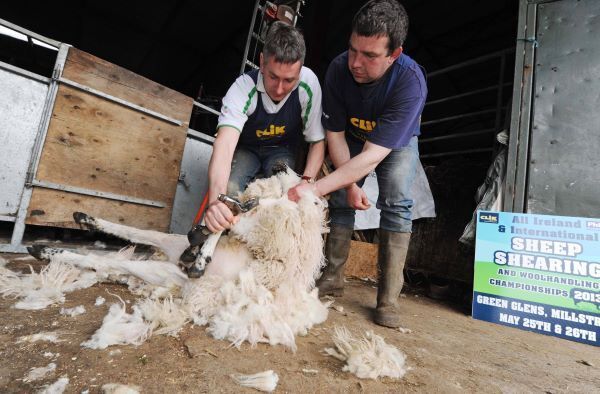
AT ‘the top of Coom’, on the Cork-Kerry border, next to Ireland’s highest pub (which is being rebuilt after a fire last year), I’m in a shed that contains a pen of sheep waiting to be shorn.
I stare at them: a worried man and worried sheep sizing each other up.
“You can kill a sheep just like that,” says farmer/publican and sheep-shearer, Tim Creedon. They’re not reassuring words for a novice sheep shearer.
“You’d want to keep out from the skin, or you could rip the skin apart,” he says.
The man standing next to Tim is multiple All-Ireland sheep shearing champion, Dan Kelleher.
Both men will participate in this year’s Clik All-Ireland and International Sheep Shearing and Wool Handling Championships in the Green Glens Arena in Millstreet.
Creedon is debuting; 70-year-old Dan will be back at the venue where he won a title three decades ago.
“I started, in my first All-Ireland, in 1958,” says Dan, “and I didn’t miss too many of them since.”
Dan was the holder for 25 years of an Irish record: he sheared 186 fully-fleeced sheep (“straight off the mountain”) in nine hours using an old-fashioned hand shears.
“Sheep shearing will never die out,” Dan says. Sheep must be sheared at least once a year. The technology has evolved from hand-held to electric shears, but it requires considerable skill and both disciplines are still practised. The traditional sheep shearing season is during the summer months, but this year’s festival will allow shearers from Ireland, the UK, New Zealand, Australia and elsewhere, to showcase their talents beforehand: the primary reason that sheep are shorn is to harvest the wool.
The wool is bagged on the spot. Dirt is removed and wet fleece is dried out, before being sold to a local wool merchant, who will be paid about €1 per kilo for a predominantly export market. Soon, it’s my turn to have a go at shearing. Tim prepares the first sheep for me by shearing the most delicate parts of its body — the soft underbelly and the backside, including the tail.
I start on the sheep’s left side, holding him still with my knees, with my hand around his head, while I put the shears close to the animal’s skin without digging into it.
Right now, I’d rather shave my own head than shave the sheep. Holding the sheep is most of the effort of sheep-shearing.
Like any sensible animal that is being forcibly shaved of its protective coat and dignity, the sheep tries to run away, and holding him down requires a determined and co-ordinated effort of my legs, knees and hands.
All the while, a lethal machine is buzzing noisily in my right hand. Sheep shearing is like shaving your face, arm-wrestling a teenager, and performing a series of squat-thrusts, all at the same time. My first efforts were tentative. I played safe, removing only a superficial layer of wool, and leaving a couple of centimetres of buffer zone, for safety, on the poor sheep. “You’ll have to go over that again,” Tim says.
“If you were in a competition, now, you’d lose a lot of marks for that.”
I became more confident with each sweep of the shears. By the time I’d got to the ‘long blow’ — the tail-to-neck run of the shears, which takes the biggest piece of fleece — I almost had a truly shorn-looking sheep.
The animal then had to be turned over for ‘the money side’, to be finished. I liked the sound of that and I found myself getting bolder as the sheep was getting balder.
When my sheep went back into the pen, he didn’t look the prettiest animal in the flock.
The wool I extracted was a messy pile of chunks, flakes, and strands (as opposed to the single piece that Tim and Dan can remove), but I had done something that I didn’t think I’d be able to do: I had gone up the mountain a man, and had come down a sheep shearer.
-
www.sheepshearing2013.ie.
CONNECT WITH US TODAY



Be the first to know the latest news and updates