Explosive past hides underlying sadness of a people railroaded apart
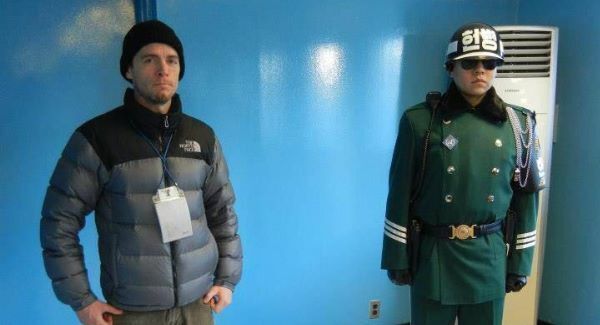
JUST over a week ago, I stood on the demilitarised border between the Democratic People’s Republic of Korea (North Korea) and the Republic of Korea (South Korea) with my fellow tourists, while a lone North Korean soldier gazed down on us impassively from his guard-post.
I had finally taken the DMZ or Demilitarised Zone tour, a jaunt for visitors along the strongly reinforced border between the two states. At times the whole scenario almost seemed like an elaborate charade; here South Korean soldiers adopt their famous aggressive stance and face towards their North Korean counterparts, but only when the tourists arrive.
Earlier in the day, we had visited a spacious, modern and eerily silent train station at Dorasan, which was built on the border in the hope that people may one day freely commute northwards into China and beyond. Some of us marked the occasion by lying down on the tracks, in the style of a 1930s silent movie’s damsel in distress; at times the whole trip had a light-hearted feel to it.
My experience at the DMZ took on a whole new light when I learned on Tuesday that North Korea had conducted their third test of a nuclear device. I have lived in South Korea for the past year, teaching English in the coastal city of Yeosu, home to World Expo 2012, but I had heard nothing of the test from anyone in Korea, and had to be told by someone in Cork.
A quick check of the English language newspaper The Korea Herald showed they had run a headline on the story, and there were news bulletins on Korean language television stations, but there was no change of atmosphere on the streets or in the people who I met that day.
This got me thinking about my time here in South Korea; how do the people of the South, including my friends and colleagues, deal with such a threatening and surreal situation as the one they live in daily on the Korean peninsula?
Korea has always been a very homogenous culture, and foreigners (or waegukin) are still an item of curiosity outside the bigger cities. One of the first things you notice here are the constant stares, as older people try to work out what the hell you are, and younger people try to see if you look like David Beckham/Lady Gaga.
To integrate in any meaningful way is difficult, and necessitates learning some of the language (a difficult task for an English speaker), but more importantly learning about Korean culture. Korea is heavily influenced by Confucianism, which is more of a social doctrine than a faith, where everybody has their place in society according to age and social status.
So Koreans appear incredibly phlegmatic, accepting a dressing down from a superior or an elder even if said elder is very wrong or insane, and stoically doing things the traditional way. This can be infuriating for a foreigner, but it’s a vital factor when considering South Koreans’ attitude towards the North.
To begin with, I shied away from mentioning the North when talking to Koreans, because I wasn’t sure how they would react. But when people compared Ireland and Korea you couldn’t ignore the topic, as the countries have too much in common: Similar size, large coastline, dominated by larger neighbours, and divided in two after a civil war (although Korea has 10 times Ireland’s population, and its economy isn’t too bad either).
Most Koreans believe Ireland is part of the UK, but many have some knowledge of the Troubles. If this came up in conversation, I would then ask them about the situation with North Korea, and would receive fairly bland, factual replies. It was only later, as I came to know the people better, that I realised replies masked a deep underlying sadness.
Many families were torn apart when the border was raised and the people of the South long to reach out to their Northern cousins; the few people that actually opened up told me how they longed for the two countries to reunite in their lifetime.
The country has remained in a state of war since the original conflict, so people must carry identification at all times and all young males must do almost two years of military service, and yet this country remains an incredibly peaceful and confident place, and is one of the safest countries I’ve lived in.
The people of South Korea do not run around screaming when the North makes an aggressive gesture; they simply get on with their lives as best they can, and strive to maintain South Korea’s status as an economic super-power.
They retain their traditions, most of which they share with the North, and hope for reunification sooner rather than later. With this in mind, the empty station of Dorasan takes on a new significance; not forlorn or poignant, but a symbol of hope for a better future.
*Paul Quinn is an archaeologist from Bandon in Co Cork who has been teaching English in South Korea for the past year.
CONNECT WITH US TODAY



Be the first to know the latest news and updates