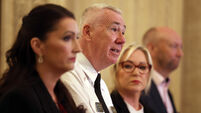
Reilly not fit to be minister: Shortall
Ms Shortall said James Reilly had “blocked [her] at every turn” in her efforts to implement reforms in primary care, for which she had responsibility. She said “there was no point in pretending I had any power as a minister of state”, so she stepped down.
Her resignation was precipitated by Dr Reilly’s decision to add two sites in his own North Dublin constituency to a list of locations selected for new primary care centres. He did this without consulting Ms Shortall and without apparent regard for the criteria used in selecting the original 35 sites.
Over the weekend, it was revealed that the two controversial sites were added on the evening before the list was announced in July.
Ms Shortall said the revelation proved her consistent claim that Dr Reilly had “not used any kind of objective criteria” in adding the two sites in Balbriggan and Swords. “I’ve maintained all along that there was no basis for Dr Reilly’s claims that he used any kind of objective criteria and I was disappointed that my Cabinet colleagues didn’t look for more supporting information at the time,” said Ms Shortall.
This included Labour leader Tánaiste Eamon Gilmore, she said.
Ms Shortall said she felt she had no option but to step down and that while she did not regret her decision, she would have “loved to have stayed on in primary care to implement reform”.
“I was blocked at every turn,” she said “James Reilly is not committed to the reforms contained in the Programme for Government. I was wasting my time.”
Ms Shortall said she did not subscribe to former health minister Mary Harney’s view that the worst day in government was better than the best day in opposition, but that she had worked hard for 15 months on major reforms that had come to nothing.
Ms Shortall said Dr Reilly was strong on rhetoric but even “big ticket” items he committed to, such as the extension of free GP care to those with long-term illnesses, had not happened. In addition, he failed to control the health budget and, by failing to invest in primary care, was using the most expensive healthcare model instead of the lower-cost model he had promised.
CONNECT WITH US TODAY



Be the first to know the latest news and updates