15-18C
Mostly cloudy

Find a...

Date Job Car Home


  • NEWS
  • Martin wades into abortion debate

    As the Dáil committee hearings continue on the abortion bill, Archbishop of Dublin Diarmuid Martin has waded into the debate saying it is important that Christian believers "be, and seen to be, on the side of life, especially when life is most vulnerable".

  • Payment cuts see families pay rent shortfall

    Limits on rent supplement payments set by the Government are forcing thousands of families to make undeclared top-up payments to landlords to secure places to live.

  • WORLD
  • Anger as North Korea launches another missile

    North Korea fired a short-range missile from its east coast, a day after launching three more of these missiles, a South Korean news agency said.

  • How Star Trek predicted the future

    WHEN Star Trek creator Gene Roddenberry first dreamed up the concept of a television show based in the unexplored universe of Outer Space in 1964, the world was a very different place.

  • BUSINESS
  • Warnings over future of eurozone

    The eurozone is heading towards a break up unless there are moves towards much closer political and fiscal union, according to chief economist with State Street Global Advisers, Chris Probyn.

  • Bruton defends corporate tax rate

    Ireland will be able to maintain its current corporation tax code in the face of international pressure to prevent multinational corporations avoid paying their fare share of tax, Minister for Jobs, Enterprise and Innovation, Richard Bruton said yesterday.

  • SPORT
  • Mayo’s statement of intent

    Galway 0-11 Mayo 4-16 Five minutes to go in Salthill yesterday and James Horan was still cajoling his men to sew it into Galway.

  • Wilkinson inspires Toulon to glory

    ASM Clermont Auvergne 15 Toulon 16 Not for the first time this season, a matchday performance and the result have made a mockery of the statistics.

  • LIFESTYLE
  • What Lenny Abrahamson did next

    LENNY Abrahamson has directed three feature films: Adam & Paul, Garage and What Richard Did.

  • Why do women love to dress up?

    Trying on clothes, said Ewart, produced "sensations which bring deep peace and perfect contentment" to the female mind.


Carbery milk supplier award winner open day, Friday, July 20

The overall Carbery milk supplier award winners for 2011 were John and Deirdre McCarthy, Butlerstown, who supply Barryroe Co-op.

They have four children — Roisin aged 9, Diarmuid (7), Clodagh (2) and Aibhlin (1). They are very involved in organising and taking part in many community activities. Adequate breaks and holidays are an important aspect of their life.

John is an officer of the local coast guard unit, and a committed board member of Barryroe Co-op.


Like most good farmers, he uses all the services available to him. He works closely with the co-op, especially Seamus O’Mahony and Teagasc adviser Seamus O’Dowd. He uses services such as milk recording, profit monitor, AI, and ICBF schemes.

He pays special tribute to Barryroe Co-op manager Peter Dineen, who he says has guided him from a very early age to where he is to day.

The McCarthys keep excellent records, which are essential for good farming.

Every year, most co-ops around Ireland hold milk supplier awards, and these are extremely useful in focussing farmers’ minds on the many different factors that are involved in sustainable production of top quality milk.

The farm walks accompanying these awards give a great opportunity to farmers to see and discuss efficient milk production and quality control.

Judging Criteria

In the old days, milk awards were generally judged only on the quality of the milk supplied, but since the 1980s, the whole farm and farm practices of the supplier are also taken into account. This of course is the correct procedure, because dairy product customers want to see where their food supply is coming from. Also it is important that the farming system is sustainable and operating in harmony with the environment.

The criteria for the Carbery awards are 60% for milk quality and 40% for other factors such as buildings, hygiene, general management, management of the environment, herd health, sustainability etc. As regards milk quality, protein, SCC, TBC and hygiene practices a re the main factors considered.

The McCarthy Farm

When I visited the McCarthy farm in the intensive dairying Barryroe Co-op a few weeks ago, it brought back a lot of memories of visiting the best dairy farms, north and south, during my years of judging dairy farm awards. My first impression was that this farm ticked all the boxes for a first class family dairy farm.

The drive into the farm revealed a beautiful and well kept residence and gardens. The entire farmyard was neat and tidy, with adequate but not elaborate buildings. Some old buildings and stone walls are maintained in good condition, which adds to the appearance of the farm.

Likewise, the whole farm was well laid out with paddocks and roadways. Most impressive of all was that this is a medium size family farm making the very best use of all the facilities available — which the majority of dairy farmers could aspire to.

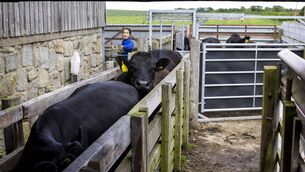
The holding around the farmyard consists of 35 hectares (7 rented). John also has an outside holding of six hectares on which he usually grows maize and grazes some heifers. On average, he milks 77 cows with average yield of 6,403 litres (1,408 gallons). The stocking rate is 2.47 cows per hectare (one cow/acre). The cows are all Holstein-Friesian and are strong and robust. Any cows that are too big are bred to British Friesian. He supplies winter milk to the Carbery scheme from about 30% of the herd.

Milk Quality

Through out the year, bulk SCCs are well under 150,000, averaging 130,000. Apart from his older cows, the milk recording shows that all other cows are comfortably under 100,000. First lactation animals averaged 60,000 for SCC last year. Bulk TBCs averaged seven last year and are even lower this year to date. Milk fat averaged 4.01%, protein 3.5% and lactose 4.74%. These are all excellent figures, especially when combined with high yields. They show what can be achieved with top class breeding , feeding and management. His dairy hygiene and milking routine are nothing exceptional, but he carefully follows the best advice available and takes no short cuts. He finds milk recording a huge help in keeping SCCs under control and of course for breeding. The milking machine is serviced twice yearly and the liners are also changed twice yearly.

Buildings

He has a ten-unit side-by-side milking parlour with jars, which is maintained in excellent condition. His cubicle unit is well planned, adjacent to the parlour. The cows exit from the parlour through a passage from which they have access to roughage buffer feeding for much of the year. There is always straw available to them, and even in times of plenty grass, they consume some straw. He has an open yard with a good supply of straw bedded housing for cows near calving or in need of individual attention.


Unusually, he has a collection system for water from the sheds which saves a lot of water, he says one hour of rain provides washing water for three days.

Farm

The farm consists of all good dry land which is well laid out in paddocks and roadways. It is reseeded regularly and contains a high level of ryegrass. This facilitates a long grazing season of about 300 days. He makes optimum use of slurry, and his use of lime, P and K is based on soil tests.

John mainly runs the farm as a one man unit but with the help of farm relief and some family assistance when required. Bull calves are sold and heifers are reared.

Performance

Overall performance on the farm from a physical and financial point of view is excellent. Peak yield from his spring calvers is generally 31 to 32 litres per cow. He maintains high yields throughout much of the season. Average yield during the third week of June was 27 litres (including autumn calvers). He increased concentrate feeding to 3 kg per cow in mid-June to counteract the poor weather conditions. His feeding policy is to get as much milk as possible from grass and introduce concentrates as necessary to maintain good yields — because if yields are left drop, it is difficult to get them back up.

Concentrate feeding on the farm in 2011 was 850kg per cow, but due to high yield, concentrate costs per litre of milk were similar to the average of the farmers in the dairy profit monitor, at 3.9 cent.

Due to involvement in the Carbery winter scheme, and high milk solids, his output per litre of milk was 40.3 cent, resulting in a high margin over meals of 36.4 cent per litre. His total costs were relatively low, due to a long grazing season and making optimum use of grass.

Profitability per cow and per acre was well within the top 10% of farmers in the dairy profit monitor scheme.

Example

Because of its size, sensible development and excellent performance, the McCarthy farm provides a perfect example for the majority of family dairy farmers. It is not easy to get to the stage where the McCarthy’s are today, but they have set a very high standard which farmers can aspire to.

An open day will be held on the farm on Friday, July 20. This is a farm walk that I would strongly recommend farmers to attend, in order to get the full details of the developments and performance on the farm. The farm will be well staffed with co-op and Teagasc personnel during the open day.

The visitors will not see any extraordinary activities or fancy ideas, just common sense and efficient sustainable dairy farming.

A visit to this open day should give great encouragement to the vast majority of farmers who are somewhat limited by land and facilities.

They will realise that hundreds of cows are not necessary for a high family farm income, despite this idea being promoted in recent years.

As I have stressed many times in my articles, it is not the number of cows that determines profitability and sustainability. In fact, records show that efficient medium sized family farms are often more profitable than large units.

The priority for the McCarthy farm in the future is to hold milk volume and increase milk solids, without any significant increase in cow numbers. Home

More from the Irish Examiner