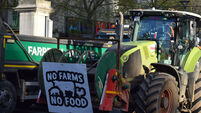
Family farms, not big business, will sustain rural communities
These words of renowned conservationist and farmer, Wendell Berry, really resonated with me upon reading them recently.
As a young organic farmer myself, I often feel that any justification for doing what I do tends to defy all logic. Some people say that farming is a lifestyle.
Well, yes it is; it’s a lifestyle that often demands 80-90 hour work weeks, where things like weekends and holidays are something that other people enjoy. Some would say that it’s nice to work outdoors.
This can be true but during a long Irish winter, there are many days no reasonable person would consider putting a dog outside, and yet Irish farmers will, day in — day out, don a hat, tell themselves they’re not made of sugar and plough on, herding, hoeing, feeding, forking.
This may sound like a complaint but I can assure you, it is not. I wouldn’t change what I do in a million years. In fact it is a testament to a deep love of farming that Ireland still has so many farmers, approximately 140,000.
They most certainly don’t do it for the money. The most recent figures from Teagasc put Ireland’s average farm income at €21,500.
And so we come back to Wendell Berry’s assessment: “They must do it for love”.
Although this is a very abstract concept, I believe it encompasses some very real aspects of a farmers outlook. A connection with the land and with nature, a sense of stewardship, taking pride in producing quality food.
These notions are enshrined in the principles of organic farming and have particular resonance in the case of the family farm. The idea that the land you farm isn’t yours as such, that you are merely a caretaker for future generations, is essential in encouraging ecological and responsible practices.
Conversely, if we fail to protect the family farm model, environmental stewardship and food production will increasingly fall into the domain of corporate agriculture.
Motivations become purely financial, short term gains trump all other concerns. The emphasis turns to quantity of production rather than quality.
In the latest round of CAP negotiations, the Government with the complicity of the IFA, have done a great disservice to our family farm model. They have avoided attempts to provide a level playing field for Irish farmers by seeking to maintain payments based on historic production.
They have argued that the most productive farmers should receive the highest payments even though, the only reason many of those farms are productive is because their high payments allow them to be.
They are attempting to water down the proposed “greening” measures to such an extent that there will be little benefit to those who are doing the most to protect our environment.
By failing to do the right things on CAP reform in favour of maintaining the status quo, the Government have committed a huge number of small, sustainable Irish farms to a further decade of struggle, stagnation or worse.
The only hope remaining is that the European Commission can stand firm on some of its proposals with regard to greening and convergence.
A key tenet of organic farming is that through diversity, we build resilience. A pasture of 30 different grasses and herbs is better for animal and environment than a monoculture with no variety. This concept would hold equally true for Ireland’s rural communities.
To ensure food security, we need to protect the small farmers, the market gardeners and the artisans. From shops to suppliers, schools and services; the rural economy hinges on the strength of the farming sector.
We have a wealth of farmers and we must protect this diversity.
Thriving rural communities will not be built or maintained by businesses producing commodities; they will be built on family farms, producing quality food.
* Gavin Lynch is a member of Organic Trust www.organictrust.ie
CONNECT WITH US TODAY



Be the first to know the latest news and updates